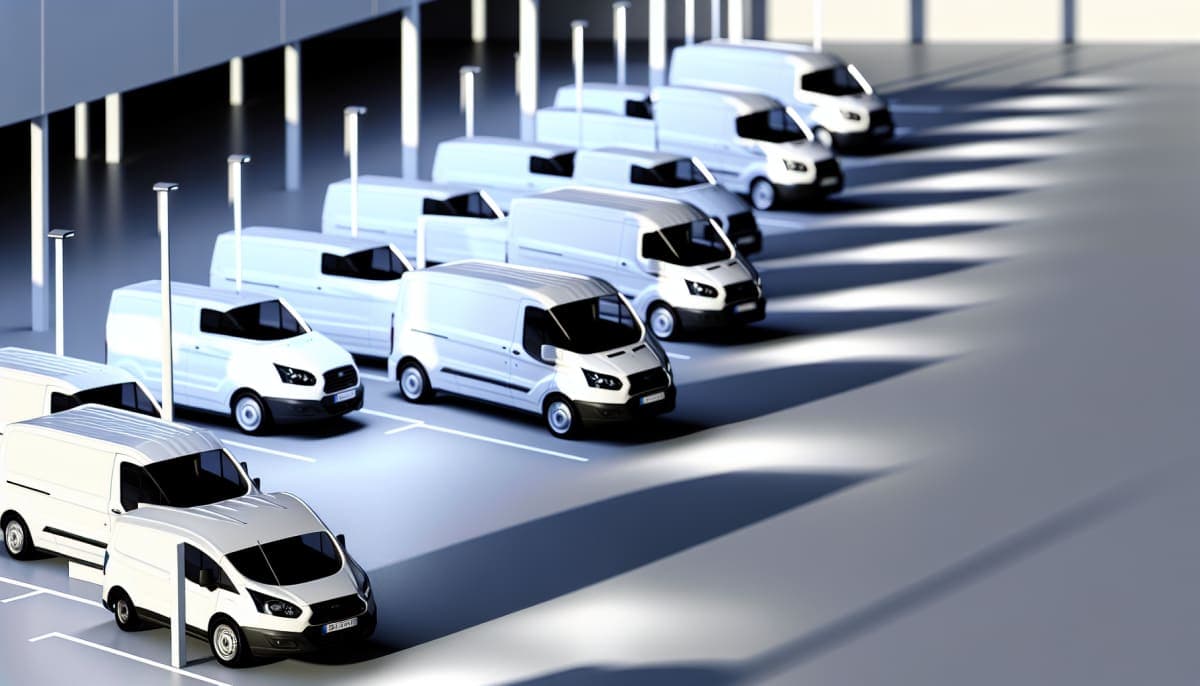
Commercial Auto Insurance: Coverage, Costs & Requirements
By PolicyBenchmark Editorial Team · Updated March 14, 2026
Commercial auto insurance protects businesses against financial losses arising from vehicle accidents, theft, vandalism, and other covered events involving vehicles used for business purposes. If your company owns, leases, hires, or borrows vehicles — or if employees drive their personal vehicles for work — commercial auto coverage is a critical component of your business insurance program.
Personal auto policies explicitly exclude vehicles used for business purposes in most cases. That exclusion means a delivery driver involved in an accident, a salesperson rear-ended while visiting clients, or a contractor whose work truck is stolen would not be covered under a personal auto policy. Commercial auto insurance fills that gap, providing liability protection, physical damage coverage, and other benefits tailored to business vehicle use. For a deeper look at cost factors and fleet management strategies, see our commercial auto insurance blog guide.
This content is for informational purposes only and does not constitute insurance advice. Always consult with a licensed insurance professional before making coverage decisions.
What Commercial Auto Insurance Covers
Commercial auto insurance provides protection across two primary categories: liability coverage for damage or injury you cause to others, and physical damage coverage for your own vehicles.
Liability coverage pays for bodily injury and property damage you cause to third parties in an at-fault accident. If your delivery driver runs a red light and collides with another vehicle, your commercial auto liability coverage would pay for the other driver's medical expenses, vehicle repairs, lost wages, and legal defense costs if they file a lawsuit. Liability coverage is required by law in every state, though minimum required limits vary.
Physical damage coverage pays to repair or replace your own vehicles when they are damaged or destroyed. This category includes collision coverage (damage from accidents) and comprehensive coverage (damage from non-collision events like theft, fire, hail, flooding, and vandalism).
Medical payments coverage pays for medical expenses incurred by you and your passengers after an accident, regardless of who was at fault. This coverage provides faster access to medical care without requiring a liability determination.
Uninsured and underinsured motorist coverage protects you and your passengers when the at-fault driver carries no insurance or insufficient insurance to cover your losses. Given that approximately 14% of drivers nationwide are uninsured according to the Insurance Research Council, this coverage provides meaningful protection.
Hired auto coverage extends your commercial auto policy to vehicles your business rents, leases, or borrows on a short-term basis. If an employee rents a car for a business trip and is involved in an accident, hired auto coverage responds to the claim.
Non-owned auto coverage applies when employees use their personal vehicles for business tasks such as running errands, making deliveries, or visiting client sites. If an employee causes an accident while driving their own car on company business, non-owned auto coverage provides excess liability protection above the employee's personal auto policy.
Types of Commercial Auto Coverage
Understanding each coverage component helps you build a policy that matches your risk profile without paying for unnecessary coverage.
| Coverage Type | What It Covers | Required? | |---|---|---| | Bodily Injury Liability | Injuries you cause to others | Yes — in all states | | Property Damage Liability | Damage you cause to others' property | Yes — in all states | | Collision | Damage to your vehicle from an accident | No — but often required by lenders | | Comprehensive | Non-collision damage (theft, fire, hail, flood) | No — but often required by lenders | | Medical Payments | Medical expenses for you and passengers | Varies by state | | Uninsured/Underinsured Motorist | Accidents caused by uninsured drivers | Required in some states | | Hired Auto | Rented or borrowed vehicles | No — but strongly worth considering | | Non-Owned Auto | Employee personal vehicles used for work | No — but strongly worth considering |
Most commercial auto policies are structured as a single "combined single limit" (CSL) or as "split limits." A CSL of $1,000,000 means the insurer will pay up to $1 million total per accident for all bodily injury and property damage combined. Split limits — such as 100/300/100 — set separate caps: $100,000 per person for bodily injury, $300,000 per accident for bodily injury, and $100,000 for property damage.
Personal Auto vs. Commercial Auto Insurance
The distinction between personal and commercial auto insurance matters because a personal policy will typically deny a claim if the vehicle was being used for business purposes at the time of the incident.
| Factor | Personal Auto | Commercial Auto | |---|---|---| | Named insured | Individual | Business entity | | Vehicles covered | Personal vehicles | Business-owned and business-use vehicles | | Driver coverage | Named household members | Any authorized employee | | Liability limits | Typically $100K–$500K | Typically $500K–$2M+ | | Usage restrictions | Personal use; excludes business use | Business use; can include personal use | | Cost | Lower | Higher — reflects commercial risk | | Hired/non-owned | Not available | Available as endorsement |
Certain uses clearly require commercial auto insurance: vehicles titled in a business name, vehicles with commercial plates, vehicles used for deliveries or transporting goods for compensation, vehicles carrying hazardous materials, and vehicles with specialized equipment or modifications for commercial use.
Some gray areas exist. An employee who occasionally uses their personal car to visit a client may be covered under their personal auto policy, depending on the insurer and the frequency of business use. However, relying on that assumption creates risk. Non-owned auto coverage on a commercial policy provides a more reliable layer of protection.
Who Needs Commercial Auto Insurance
Any business that owns, leases, or regularly uses vehicles for business purposes may want to consider commercial auto insurance. Specific scenarios where commercial auto is particularly important include:
Businesses that own vehicles — If any vehicle is titled in a business name, personal auto insurance will not cover it. This includes company cars, delivery vans, service trucks, and any other business-owned vehicles.
Businesses with fleets — Companies operating multiple vehicles benefit from fleet-rated commercial auto policies, which can offer volume discounts and simplified administration.
Delivery and transportation businesses — Any business that delivers goods, transports passengers, or moves materials needs commercial auto coverage. This includes restaurants with delivery drivers, florists, courier services, and moving companies.
Contractors and tradespeople — Electricians, plumbers, HVAC technicians, landscapers, and other contractors who drive to job sites and carry tools and equipment in their vehicles need commercial auto coverage.
Businesses with traveling employees — Sales teams, consultants, real estate agents, and other professionals who regularly drive for work create liability exposure that should be covered.
For-hire transportation — Ride-share drivers, livery services, and trucking companies face specific commercial auto requirements that personal policies do not address.
How Much Does Commercial Auto Insurance Cost
Commercial auto insurance premiums vary widely based on multiple factors. Most businesses pay between $1,200 and $3,600 per vehicle per year, though costs can be significantly higher for high-risk industries or drivers with poor records.
Average annual premiums by vehicle type:
| Vehicle Type | Typical Annual Premium | |---|---| | Passenger car (sales, errands) | $1,200 – $2,000 | | Pickup truck (contractor) | $1,500 – $2,800 | | Cargo van (delivery) | $1,800 – $3,200 | | Box truck (moving, freight) | $2,500 – $4,500 | | Tow truck | $3,000 – $6,000 | | Semi-truck/tractor-trailer | $8,000 – $15,000+ | | Food truck | $2,000 – $4,000 |
Factors that affect your commercial auto premium:
Vehicle type and value — Heavier, more expensive vehicles cost more to insure. A box truck carrying $50,000 in cargo presents a greater financial exposure than a sedan used for client visits.
Driver records — Clean driving records result in lower premiums. Insurers pull motor vehicle reports (MVRs) for all listed drivers and may decline coverage for drivers with serious violations such as DUI/DWI convictions, reckless driving charges, or multiple at-fault accidents.
Industry and use — Delivery businesses, long-haul truckers, and for-hire transportation companies pay more than businesses using vehicles for occasional errands. The frequency and nature of vehicle use directly impacts risk.
Annual mileage — Higher mileage increases exposure to accidents. Vehicles driven 30,000+ miles per year will cost more to insure than those driven 10,000 miles.
Coverage limits and deductibles — Higher liability limits increase premiums, though the marginal cost of additional coverage is often modest. Higher physical damage deductibles reduce premiums but increase out-of-pocket costs after a claim.
Operating radius — Vehicles operating primarily within a local area cost less to insure than those covering long-haul routes across multiple states.
Claims history — A history of prior claims increases premiums. Businesses with clean claims records are eligible for experience credits.
State of operation — Insurance costs vary by state due to differences in required minimums, litigation environments, and repair costs. Michigan, Louisiana, and Florida consistently rank among the most expensive states for commercial auto coverage.
Number of vehicles — Fleet policies (typically five or more vehicles) may qualify for volume discounts. The overall fleet composition and aggregate risk profile influence pricing.
State Requirements for Commercial Auto Insurance
Every state requires minimum liability insurance for vehicles operated on public roads. However, the minimum limits vary, and most insurance professionals consider the state minimums insufficient for business use. Use our state requirements checker to look up the specific requirements for your state.
Examples of state minimum liability requirements:
| State | Minimum Bodily Injury | Minimum Property Damage | |---|---|---| | California | $15,000 / $30,000 | $5,000 | | Texas | $30,000 / $60,000 | $25,000 | | New York | $25,000 / $50,000 | $10,000 | | Florida | $10,000 (PIP) | $10,000 | | Illinois | $25,000 / $50,000 | $20,000 | | Pennsylvania | $15,000 / $30,000 | $5,000 |
State minimums are designed as a floor, not as a guideline for adequate coverage. A serious accident involving a commercial vehicle can easily result in damages exceeding $500,000. Businesses may want to consider liability limits of at least $500,000 CSL, and many carriers, industry contracts, and motor carrier authorities require $1,000,000 or more.
Federal requirements for motor carriers — Businesses operating vehicles in interstate commerce face federal minimum insurance requirements set by the Federal Motor Carrier Safety Administration (FMCSA). For-hire carriers transporting general freight must maintain a minimum of $750,000 in liability coverage. Carriers transporting hazardous materials face minimums of $1,000,000 to $5,000,000 depending on the type of cargo.
Frequently Asked Questions
Does my personal auto insurance cover business use?
In most cases, no. Personal auto policies contain exclusions for vehicles used in business operations, particularly for delivery, transportation of goods or passengers for compensation, and vehicles titled in a business name. Some personal policies allow limited business use — such as commuting or occasional client visits — but the line between personal and business use is often unclear. To avoid coverage disputes, businesses may want to consider a commercial auto policy for any vehicle regularly used for business purposes.
Do I need commercial auto insurance if employees drive their own cars for work?
Yes, this is worth considering. When employees use personal vehicles for business tasks, your company can be held liable for accidents that occur during those trips under the legal doctrine of "respondeat superior." Non-owned auto coverage on a commercial auto policy provides excess liability protection above the employee's personal auto limits. Without this coverage, a gap exists between the employee's personal auto policy and the business's liability exposure.
What is the difference between hired auto and non-owned auto coverage?
Hired auto coverage applies to vehicles your business rents, leases, or hires on a temporary basis — such as rental cars for business trips or short-term vehicle leases. Non-owned auto coverage applies when employees drive their personal vehicles for business purposes. Both coverages are typically available as endorsements on a commercial auto policy, and many businesses carry both to ensure comprehensive protection.
How does commercial auto insurance handle multi-state operations?
Commercial auto policies generally follow the vehicle, meaning coverage applies wherever the vehicle is operated within the United States and Canada. If your business operates vehicles in multiple states, your policy will automatically adjust to meet the minimum requirements of each state where vehicles are driven. However, if you garage vehicles in multiple states, you may need to list each garaging location on your policy to ensure proper rating and compliance.
Are there commercial auto options for owner-operators and single-vehicle businesses?
Yes. Many carriers offer commercial auto policies for single-vehicle businesses and owner-operators. These policies provide the same coverage categories as fleet policies — liability, collision, comprehensive, and medical payments — but are priced for individual vehicles. Owner-operators in the trucking industry can also purchase occupational accident insurance to provide workers' compensation-like benefits, since they are typically classified as independent contractors rather than employees.
What happens if an unlisted driver has an accident in a company vehicle?
Coverage depends on your policy language. Some commercial auto policies cover any driver operating the vehicle with the business's permission, even if that driver is not specifically listed on the policy. Other policies restrict coverage to named or scheduled drivers only. Permissive use policies are more common, but it is important to verify your policy's terms. Allowing unlisted drivers to operate company vehicles without confirming coverage creates significant risk exposure.
Does commercial auto insurance cover tools and equipment in the vehicle?
Standard commercial auto policies provide limited coverage for permanently installed equipment but generally do not cover loose tools, supplies, or cargo stored in the vehicle. A contractor's tools stolen from a work truck, for example, would typically not be covered under commercial auto insurance. Inland marine insurance or a tools and equipment floater is the appropriate coverage for portable business property transported in vehicles. Some insurers offer endorsements that extend commercial auto coverage to include specified equipment.
How is commercial auto different from a commercial trucking policy?
Commercial trucking policies are specialized commercial auto policies designed for for-hire motor carriers — businesses that transport goods or passengers for compensation. Trucking policies include coverage features specific to the industry, such as trailer interchange coverage, motor cargo insurance, bobtail/deadhead liability, and compliance with FMCSA filing requirements (MCS-90 endorsement). A standard commercial auto policy is designed for businesses that own and operate vehicles but are not in the business of transporting others' goods for hire.
Compare Coverage Options
Use our free quiz to find out which insurance types your business needs.
Take the Insurance Quiz